

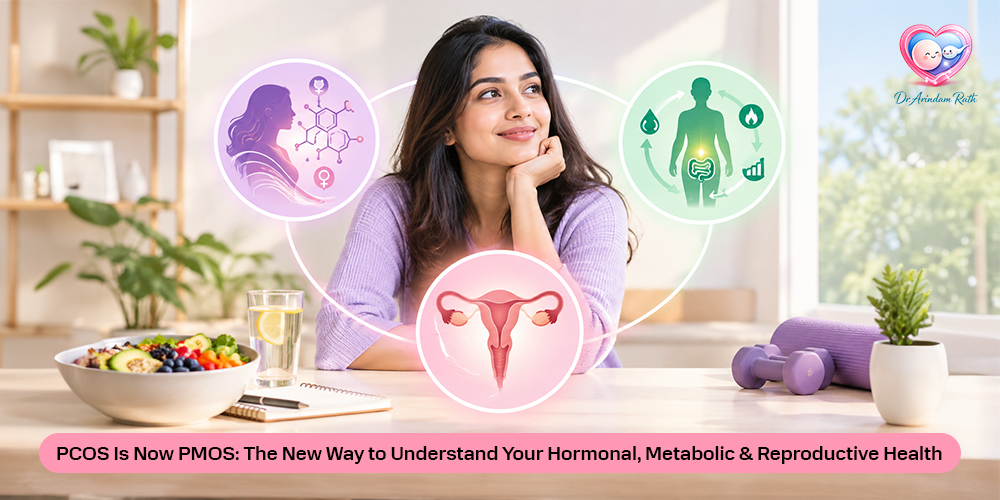
It Was Never Just About Ovarian Cysts
For years, women have heard the term PCOS, or Polycystic Ovary Syndrome, and often associated it with irregular periods, weight gain, acne, unwanted hair growth or difficulty getting pregnant. But PCOS was never simply a problem of the ovaries.
It can affect hormonal health, ovulation, metabolism, fertility, emotional well-being and long-term health.That broader understanding has now been reflected in an important terminology change.
In May 2026, the international evidence-based guideline introduced PMOS, or Polyendocrine Metabolic Ovarian Syndrome, as the new name for the condition previously known as PCOS. The change is intended to better communicate that the condition involves much more than ovarian appearance.
So, if you have been searching for PCOS Treatment in Kolkata, wondering about PCOS and Fertility, or simply trying to understand what your diagnosis means, there is an important message to remember:
Your ovaries are only one part of the picture. You are the whole picture!
Why Has PCOS Been Renamed PMOS?
The word “polycystic” has often led women to believe that cysts are the central problem.
That can create a common misconception:
“I have PCOS because I have cysts on my ovaries.”
But that is not how the condition is diagnosed.
The international guidelines recognise several different features, including:
• Hyperandrogenism, meaning elevated androgen levels or clinical signs such as excess hair growth or acne
• Ovulatory dysfunction, often reflected through irregular menstrual cycles
• Polycystic ovarian morphology on ultrasound
• In adults, anti-Müllerian hormone can also be used as an alternative to ultrasound within the appropriate diagnostic pathway.
Importantly, a woman with irregular periods and hyperandrogenism may not need an ovarian ultrasound to establish a diagnosis of PCOS.
That is why the new term Polyendocrine Metabolic Ovarian Syndrome is significant.
It shifts attention from simply asking: “What do the ovaries look like?” to asking: “What is happening throughout the woman’s hormonal, metabolic and reproductive health?”
PMOS Is More Common in India Than Many Women Realise
PCOS is not a rare condition.
A large Indian cross-sectional study involving 9,824 women aged 18 to 40 years found a weighted national prevalence of 7.2% using the older NIH diagnostic criteria and 19.6% using the Rotterdam criteria. The difference demonstrates how prevalence estimates can change depending on the diagnostic criteria used.
An earlier systematic review and meta-analysis of Indian studies found a pooled PCOS prevalence of approximately 11.3% using Rotterdam criteria, although the researchers highlighted significant differences between studies and the need for more consistent diagnostic approaches.
The newer Indian study also revealed why PCOS should not be viewed as merely a fertility or menstrual problem.
Among women with PCOS in that study:
• 43.2% had obesity
• 91.9% had dyslipidemia
• 24.9% had metabolic syndrome
• 32.9% had non-alcoholic fatty liver disease
• 8.3% had hypertension
• 3.4% had diabetes
These findings do not mean every woman with PMOS will develop these conditions. But they highlight why comprehensive health assessment matters.
PMOS is not simply about periods. It is about the bigger health picture.
What Does PMOS Actually Affect?
The symptoms of PMOS can look very different from one woman to another. One woman may primarily experience irregular periods. Another may struggle with acne or unwanted hair growth. Another may have difficulty conceiving. Someone else may have significant metabolic concerns without dramatic reproductive symptoms.
Common features can include:
a. Irregular Periods
Changes in ovulation can lead to periods that are delayed, infrequent or unpredictable.
Irregular cycles should not simply be dismissed as “normal for me”, particularly when they persist.
b. Excess Hair Growth
Higher androgen activity can contribute to unwanted facial or body hair.
c. Acne and Oily Skin
Hormonal changes may contribute to persistent acne, particularly when it occurs alongside other signs of androgen excess.
d. Hair Thinning
Some women experience female-pattern hair thinning or increased hair loss.
e. Weight and Metabolic Changes
PMOS can be associated with insulin resistance, changes in lipid levels and other metabolic concerns. Importantly, PMOS can occur in women across different body sizes. A woman’s weight alone cannot confirm or rule out the condition.
f. Difficulty Conceiving
Ovulatory dysfunction can make conception more difficult for some women.
This is where PCOS and Fertility become closely connected.
PCOS and Fertility: Can You Still Become a Mother?
One of the first questions many women ask after a PCOS diagnosis is:
“Will I be able to have a baby?”
The answer is reassuring.
PCOS does not mean that pregnancy is impossible.
The challenge is that irregular ovulation can reduce the frequency with which an egg is released, making conception more difficult for some women.
That does not mean motherhood is out of reach.
Depending on the individual situation, fertility care may involve lifestyle optimisation, ovulation-inducing medication, management of metabolic or hormonal concerns, or assisted reproductive techniques when appropriate.
A fertility specialist may assess factors such as:
• Menstrual and ovulation patterns
• Hormonal profile
• Ovarian function
• Metabolic health
• Semen parameters of the male partner
• Other factors that may influence conception
The important point is that PCOS Pregnancy Treatment should never be a one-size-fits-all formula. The right approach depends on the woman, her reproductive goals and the factors affecting conception.
Why Lifestyle Is an Important Part of PMOS Management
There is no single lifestyle plan that works identically for every woman with PMOS. However, healthy lifestyle habits remain an important part of PCOS Management. It extends to:
a. Nutrition
A balanced eating pattern that includes adequate protein, fibre, vegetables, whole foods and appropriate healthy fats can support overall metabolic health. The goal should not be extreme dieting.It should be creating sustainable habits that support the body over the long term.
b. Physical Activity
Regular physical activity can support cardiovascular fitness, metabolic health and insulin sensitivity.The best exercise is often the one you can maintain consistently.
c. Sleep
Poor sleep can affect energy, mood and metabolic health.Creating a consistent sleep routine can therefore be an important part of comprehensive PMOS care.
d. Stress and Emotional Well-being
PCOS can affect more than physical health.The emotional impact of acne, hair changes, weight concerns, irregular periods and fertility difficulties can be significant.That is why modern PCOS Management should consider quality of life and psychological well-being alongside physical symptoms. As such, the international guideline specifically emphasises emotional well-being and quality of life as important components of care.
Hormonal Imbalance Treatment Should Begin With Understanding the Cause
The phrase “hormonal imbalance” is often used very casually. But hormonal symptoms can have different causes.Irregular periods, acne, hair growth or difficulty conceiving do not automatically mean that a woman has PMOS. A proper assessment may involve menstrual history, physical examination, relevant hormonal testing and metabolic evaluation. Other conditions that can produce similar symptoms may also need to be excluded. That is why Hormonal Imbalance Treatment should never be based simply on an internet symptom checklist.
Diagnosis comes before treatment.
And treatment should be based on the woman’s symptoms, health risks and reproductive goals.
PMOS and Pregnancy: What Changes?
For women planning pregnancy, PMOS requires a slightly different focus.
The goal is not simply to make periods regular.
The focus is on understanding whether ovulation is occurring, identifying other fertility factors and optimising overall health before conception.
Pregnancy itself can also require appropriate monitoring because women with PMOS may have increased risks of certain pregnancy complications.
This is why preconception counselling can be valuable. Instead of waiting until pregnancy occurs to address every concern, women can discuss their reproductive and metabolic health beforehand.
Planning ahead can make fertility care more informed and personalised.
When Should You Consult a PCOS Specialist in Kolkata?
You do not have to wait until fertility becomes a problem to seek medical advice.
Consider consulting a PCOS Specialist in Kolkata if you experience:
• Persistently irregular or absent periods
• Excess facial or body hair
• Persistent hormonal acne
• Unexplained hair thinning
• Difficulty with weight or metabolic health
• Difficulty conceiving
• A previous diagnosis of PCOS
• Concerns about ovulation
• PCOS-related fertility concerns
If you are planning pregnancy, an early consultation can help identify whether ovulation and other reproductive factors need attention. And if conception has already been difficult, consulting a Fertility Specialist in Kolkata can help determine whether PCOS is the only factor involved or whether other fertility issues also need to be evaluated.
Does PCOS Always Require IVF?
No. This is another common misconception. Having PCOS does not automatically mean that you need IVF Treatment in Kolkata. Many women with PCOS conceive without IVF, depending on their individual circumstances. If ovulation is the primary issue, a fertility specialist may first consider appropriate ovulation-focused treatment. If other factors are present, assisted reproductive techniques may become part of the treatment plan.
IVF may be considered when clinically appropriate, but it should not be viewed as the automatic next step after a PCOS diagnosis.
Treatment should match the problem, not simply the diagnosis.
What Has Really Changed From PCOS to PMOS?
Perhaps the biggest change is not the acronym. It is the way we look at the condition.
PCOS encouraged many people to focus on:
• Periods.
• Ovaries.
• Cysts.
• Fertility.
PMOS encourages a broader conversation around:
• Hormones.
• Ovulation.
• Metabolism.
• Mental well-being.
• Long-term health.
• Fertility.
The new terminology does not mean that everything previously called PCOS has suddenly become a different disease.
Rather, it reflects a broader understanding of the same complex condition and its many dimensions. The 2026 international guideline continues to build on established diagnostic criteria while placing greater emphasis on metabolic, cardiovascular, psychological and reproductive health.
PMOS Does Not Define Your Future
A diagnosis can feel frightening when you do not know what it means. But PMOS does not determine whether you will become a mother. It does not define your appearance. It does not determine your femininity. And it “CERTAINLY” does not mean that every woman will experience the same symptoms or complications.
What matters is understanding your individual health profile and addressing concerns at the right time. Whether your priority is regulating your periods, improving metabolic health, managing hormonal symptoms or planning a pregnancy, the right care begins with looking beyond a single symptom.
You are more than a diagnosis.
A Message from Dr. Arindam Rath:
“If you have been told that you have PCOS, you do not have to undergo the diagnosis with fear or confusion.
The important thing is to understand what is happening inside your body and what your individual health and fertility goals require.”
At Dr. Arindam Rath’s fertility practice, the focus is on understanding the complete picture rather than treating one report or one symptom in isolation.
Whether you are looking for PCOS Treatment in Kolkata, guidance for PCOS and Fertility, personalised PCOS Pregnancy Treatment, or specialised Infertility Treatment, the first step is a proper evaluation.
• Do not ignore persistently irregular periods.
• Do not self-diagnose based on an ultrasound report.
• Do not assume that PCOS means infertility.
If you have concerns about your periods, hormones, fertility or a previous PCOS diagnosis, consult Dr. Arindam Rath, one of the finest Fertility Specialist in Kolkata, for personalised medical guidance.
Understand your hormones. Protect your health. Plan your future with clarity.